
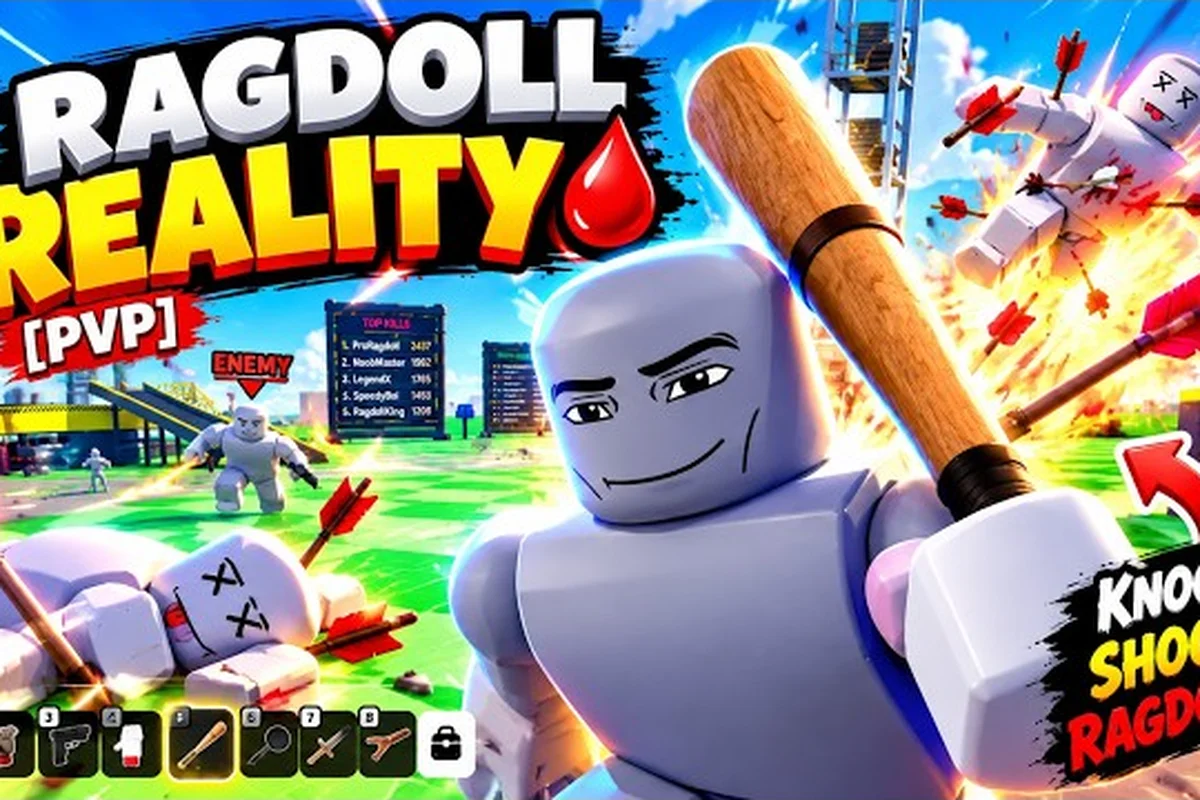
Ragdoll Reality’s sniper is strongest when long-range precision matters: its scoped weapon lets players target distant enemies before they close the gap, making it ideal for reconnaissance, defensive positions, and carefully timed eliminations. However, it does not replace the minigun for suppressing crowds, the flamethrower for controlling clustered enemies, or the shotgun for point-blank pressure. Comparing six weapon archetypes shows that the sniper excels in range and accuracy, while those close-quarters weapons offer better coverage and stopping power in their strongest scenarios.
Sniper Performance and Role in Ragdoll Reality
Ragdoll Reality is sniper good in the sense that it rewards deliberate aim and distance control, not in the sense that it is universally the strongest weapon. The official Ragdoll Reality game page lists the Sniper among a roster of more than twenty weapons, alongside Fists, Push, Grab, Pistol, Bat, Machete, Shotgun, Minigun, Rocket Launcher, Flamethrower, and C4. It does not publish damage, ammunition, fire-rate, or cooldown figures, so this comparison evaluates the weapon roles visible in the sandbox rather than invented statistics.
That distinction matters because a tier list without official numbers should be presented as an editorial judgment. The sniper’s clearest advantage is precision at a distance. It can create a controlled elimination without requiring the player to enter a dense group of physics-driven enemies. Its weakness is equally clear: if targets close the gap, the weapon’s deliberate rhythm leaves fewer answers than a rapid-fire or explosive option.
| Sniper question | Best-supported answer |
|---|---|
| Is it effective at long range? | Yes, because precision is its defining role |
| Is it ideal for close combat? | No, especially against several nearby targets |
| Is it a general-purpose weapon? | Not really; it specializes in controlled engagements |
| Is it better than every rival? | No; each rival has a stronger context |
| Does official data establish a tier? | No, because the page provides no ranking or weapon statistics |
What Makes the Sniper Stand Out
The sniper rewards players who can identify a target, create space, and commit to a shot. That makes it useful for controlled testing, distant targets, and scenarios where one precise hit is preferable to spraying an area. It also creates a distinct rhythm: locate the target, settle the aim, and time the shot instead of holding the trigger through a chaotic crowd.
This precision is the basis of a role-based S tier in a broader Ragdoll Reality tier list, but the label should be read carefully. A sniper can feel excellent in the right position and frustrating when the play space collapses. Its value depends on preserving target separation, which means the surrounding environment matters almost as much as the weapon itself.
Players who want a simpler starting point can use the Ragdoll Reality Roblox guide to learn the sandbox basics before investing time in advanced positioning. The key lesson is to test weapons against the same target at different distances rather than treating a brief demonstration as a complete tier ranking.
Precision Versus Spontaneous Fire
A rapid weapon removes much of the demand for a perfect shot, while a sniper concentrates value in that moment. If a target is moving unpredictably or several bodies are blocking the line of fire, precision becomes less useful than continuous pressure. The pistol occupies a middle position: it is easier to bring into a close encounter, although it does not offer the sniper’s range.
The same reasoning applies to the shotgun. Its strength comes from delivering force at close range, whereas the sniper chooses a thinner, more deliberate pattern. Neither weapon wins every encounter simply because it has a higher conceptual power level. The more useful comparison asks which one solves the immediate problem without wasting time on empty space or distant targets.
Six-Weapon Comparison: Sniper Against Five Ranged Rivals
The official roster includes six relevant ranged options: Pistol, Shotgun, Sniper, Minigun, Rocket Launcher, and Flamethrower. Their published descriptions establish different functions—single-target precision, spread impact, sustained fire, explosive force, and area denial—but not enough numerical data for a measured damage ranking. The table therefore compares intended roles, ideal spacing, and common failure points.
| Weapon | Primary strength | Best working distance | Main weakness | Relative sniper verdict |
|---|---|---|---|---|
| Sniper | Precision and controlled elimination | Long | Weak close-range response | Strong specialist |
| Pistol | Accessible ranged damage | Medium | Limited heavy-group pressure | Better all-rounder at close range |
| Shotgun | Strong close-range spread | Short | Less useful against distant targets | Sniper wins at range |
| Minigun | Sustained crowd pressure | Medium to long | Heavy fire demands and lower shot precision | Minigun wins for dense crowds |
| Rocket Launcher | Explosive area impact | Medium to long | Splash placement and collateral positioning | Rocket wins against grouped targets |
| Flamethrower | Continuous area denial | Very close to medium | Narrow firing cone and exposure | Flamethrower wins inside a packed zone |
This comparison shows why “good” depends on the encounter. The sniper beats the shotgun when distance is available, but the shotgun can punish a missed approach more effectively. The sniper also beats the pistol for a clean, distant shot, while the pistol is easier to use when targets appear suddenly at medium range. Against groups, explosive and sustained-fire options gain the advantage because they affect space rather than one selected point.
Direct Matchups That Define the Sniper
Against the pistol, the sniper is better when visibility and line of fire are clean. The pistol wins when targets are too close for a steady shot or when the player needs a rapid follow-up after the first elimination. Against the shotgun, the sniper’s superior reach is decisive, although the shotgun has a much stronger close-range role.
Against the minigun, precision loses to coverage. One carefully placed sniper shot may look cleaner, but the minigun can pressure a moving cluster and continue firing as the group shifts. Against the rocket launcher, the sniper offers better single-target economy, while the rocket can punish multiple tightly grouped dummies. Against the flamethrower, the sniper wins at separation, whereas the flamethrower turns a compressed corridor into an area-denial zone.
| Matchup | Stronger choice | Reason |
|---|---|---|
| Sniper versus pistol | Sniper at range; pistol up close | Precision and reach versus fast close-range response |
| Sniper versus shotgun | Sniper at range; shotgun up close | Narrow precision versus concentrated spread |
| Sniper versus minigun | Depends on target density | One clean shot versus sustained coverage |
| Sniper versus rocket launcher | Depends on grouping | Precision against a single target versus area impact |
| Sniper versus flamethrower | Sniper with space | Distance control versus close-range area denial |
Sniper Strengths, Weaknesses, and Practical Use
The sniper’s strongest use is deliberate single-target work. It suits a player who can maintain distance, watch how the ragdoll physics move, and avoid releasing the shot until the target is isolated. This is why the weapon can look exceptional in a quiet area: each action has a visible purpose, and there is little need to compensate for missed aim with additional fire.
Its central weakness is not merely low close-range power, which is not officially quantified, but situational compression. When enemies arrive from multiple directions, the player must either reposition, switch weapons, or accept a less precise shot. The official game page does not provide cooldown data, so players should judge the transition by testing rather than assuming an exact downtime.
| Sniper trait | Practical effect | Best response |
|---|---|---|
| Long-range accuracy | Rewards clear sightlines | Create distance before firing |
| Narrow target focus | Less effective against groups | Isolate a target or use crowd control |
| Deliberate firing rhythm | Can create pressure in a standoff | Time the shot rather than panic-shooting |
| Close-range inconvenience | Reduces effectiveness in a swarm | Switch to shotgun, flamethrower, or minigun |
| Lack of published stats | Makes exact ranking uncertain | Compare feel in controlled tests |
How to Test the Sniper Fairly
A fair test requires the same target, arena, and objective across all six weapons. Test at three distances: close, medium, and long. At close range, record whether the sniper can land before being surrounded. At medium range, check how quickly it can repeat a shot. At long range, compare the precision needed for a hit and the usefulness of the effect.
A useful checklist is to score each sniper on four observable measures at every range: time-to-confirmation, hit consistency against ragdoll motion, ability to create space with a single shot, and performance against clustered targets. For example, a weapon may confirm an elimination quickly on a stationary dummy yet lose much of that advantage against a moving ragdoll, while a slower weapon may outperform it when its effect applies across a group. This comparison is especially important in Ragdoll Reality, where target physics and sandbox objectives can amplify a weapon’s practical value beyond its listed damage.
- Use the same stationary dummy for the first range test.
- Repeat every test with a moving ragdoll to measure tracking demands.
- Test one target before testing a group of three or more.
- Record time-to-confirmation, not only the visual impact.
- Change weapons only after the first test is complete.
- Note whether the sandbox objective rewards elimination, area denial, or survival.
The results should be interpreted carefully because the official page does not give numerical values. Community experience and player reports are useful for describing weapon feel, but they should not be presented as verified damage charts. A weapon that looks stronger in one clip may be benefiting from a favorable target arrangement rather than a superior published stat.
When to Equip Something Else
Equip the minigun when the main problem is a sustained crowd. Equip the shotgun when a target reaches the edge of your space and you need a forceful close-range answer. Equip the flamethrower when enemies are compressed into a narrow lane, and equip the rocket launcher when a clustered target is positioned where explosive area damage is useful. The pistol remains the simplest option when a general ranged weapon is needed and precise long-range aim is not the priority.
The Ragdoll Reality best weapon for hordes analysis expands on those crowd-focused situations. The useful distinction is between area coverage and precision. The sniper is excellent at the latter, so treating it as a horde weapon simply because it can produce a powerful elimination overlooks the crowd-control problem it does not solve.
Weapon-by-Weapon Judgment and Recommended Loadouts
The question of whether Ragdoll Reality is sniper good has a clear answer when evaluated as a specialized tool. It is a high-value weapon for long-range control, clean single-target engagements, and deliberate experimentation. It is not the safest default for every situation, especially when enemies surround the player or the arena leaves no room to aim.
Sniper Loadout Profile
The ideal sniper profile keeps the player at the edge of the active area, favors one target at a time, and prioritizes accuracy over speed. A practical loadout might pair the sniper with a pistol for immediate backup, although weapon-switching costs are not published and should be tested. The backup should cover the moment when a target closes the distance, not be treated as an equal replacement.
Long-range specialist: A Sniper paired with a close-range answer creates the most balanced loadout for mixed encounters, as shown by the “Precise long-range control” pairing in the table. The Sniper handles isolated targets, while the Pistol remains available for a target that closes the gap after the first shot; the key is to use the backup only when positioning breaks down, not as an equal replacement for the Sniper.
Single-target specialist: The sniper can remain the centerpiece when the scenario consistently provides open space. This profile is less forgiving of sudden close-range spawns, so positioning becomes part of the weapon choice. In a wide outdoor arena, a clean Sniper line can control isolated targets without forcing a weapon switch, but a target emerging beside the player removes that advantage. Holding an escape lane, using elevation, and avoiding close-range spawns are therefore practical requirements for the “precise long-range control” setup, while the backup pistol matters only when the first shot fails to create safe distance.
Controlled sandbox test: Use one Sniper loadout and one crowd loadout, then change only the weapon in repeated trials. This method makes it easier to distinguish a genuine role difference from a lucky sequence. For example, run the same outdoor encounter with Sniper, Shotgun, Minigun, and Flamethrower while keeping target order, spawn timing, and health fixed; record whether the Sniper creates safer spacing or whether a crowd weapon actually clears more bodies before it is overwhelmed. The comparison should also track missed shots, damage taken, and weapon-switch timing, since the table’s “Precise long-range control” pairing only supports a Sniper advantage when those results hold under controlled conditions.
| Player goal | Primary weapon | Secondary choice | Reason |
|---|---|---|---|
| Precise long-range control | Sniper | Pistol | Keeps an answer after the first shot |
| Fast medium-range combat | Pistol | Sniper | More adaptable to sudden targets |
| Dense close-range crowds | Shotgun or Minigun | Flamethrower | Covers multiple nearby bodies |
| Grouped outdoor targets | Rocket Launcher | Sniper | Combines area impact with a precision option |
| Narrow corridor control | Flamethrower | Shotgun | Sustains pressure at close range |
Why the Other Weapons Still Matter
Ragdoll Reality is minigun good for crowd pressure because sustained fire can match several moving targets, although that comes at the cost of aiming precision and a heavier commitment to continuous use. The dedicated minigun analysis goes further into crowd control, while the central comparison here is simple: the sniper selects one target; the minigun pressures the whole formation.
Ragdoll Reality is rocket launcher good when grouped targets justify an explosive tool. Its value comes from area impact, but placement becomes important because a poor launch can affect the wrong part of the sandbox. The sniper is safer for one carefully selected target. The rocket is stronger against a cluster when the cluster is compact and the player can preserve safe distance.
Ragdoll Reality is flamethrower good in confined areas where continuous fire denies space. Its narrow operating range means it should not be selected for an open, distant engagement. Compared with the sniper, it sacrifices precision and reach for immediate area pressure. The player’s positioning determines which one feels stronger.
Ragdoll Reality is shotgun good at short range because it answers the exact problem the sniper handles poorly: a target that has closed the distance. A shotgun can punish a fast approach with concentrated spread, while the sniper may have too little room for a careful shot. The shotgun does not need to be “better” overall; it simply has the stronger role match.
Ragdoll Reality is pistol good when versatility matters more than maximum range. The pistol is easier to use against mixed distances and sudden targets, while the sniper rewards patience. It may not produce the same signature impact, but it can keep the player in the fight when positioning breaks down.
Best Choice by Situation
| Situation | Best specialist | Acceptable alternative |
|---|---|---|
| One distant target | Sniper | Pistol |
| Several nearby targets | Minigun or shotgun | Flamethrower |
| Tightly grouped targets | Rocket Launcher | Minigun |
| Narrow corridor | Flamethrower | Shotgun |
| Unclear mixed engagement | Pistol | Switch after target spacing is known |
The official page’s Halloween details add another useful context. It describes slow, normal, and fast zombie classes, a graveyard conversion point, infected dummies, and a Horde wave-survival mode. Since zombie health, bite damage, and wave population are not published, these classes support role reasoning rather than exact power calculations. Against a horde, the minigun or flamethrower may fit the survival objective better; against a distant special target, the sniper may be the more efficient choice.
Final Tier Judgment for the Sniper
Ragdoll Reality is sniper good? Yes, as a high-tier precision specialist that excels when distance, visibility, and target selection are under the player’s control. It is not clearly better than the pistol, shotgun, minigun, rocket launcher, or flamethrower, because each weapon owns a different encounter. The sniper loses ground when targets become numerous, close, or difficult to isolate.
The best practical judgment is therefore conditional. Use the sniper for controlled long-range work, use the pistol for adaptable medium-range pressure, and keep close-range crowd weapons accessible when the situation changes. This conclusion fits naturally into a broader Ragdoll Reality tier list, where weapon rank reflects both performance and the specific role a player expects it to fill.
Frequently Asked Questions
Is the Sniper the best weapon in Ragdoll Reality?
The Sniper is among the strongest choices for precise, long-range eliminations, but it is not the best weapon in every situation. The official game page does not provide damage, ammunition, cooldown, or ranking data, so the Sniper should be judged by its role: controlled single-target work rather than close-range crowd control.
Should I use the Sniper instead of the Pistol?
Use the Sniper when you have clear space and want precision at a distance. Use the Pistol when targets appear at mixed ranges, when an encounter may suddenly become close, or when you prefer a more adaptable weapon. A strong loadout can include both, with the Pistol covering situations where a careful sniper shot is difficult.
Is the Sniper better than the Shotgun and Minigun?
The Sniper is better for isolated targets because it emphasizes accuracy and reach. The Shotgun is stronger for close-range spread, while the Minigun is better suited to sustained pressure on several targets. The right choice depends on target distance and density rather than a universal damage ranking.
Is the Rocket Launcher or Flamethrower better for crowds?
The Rocket Launcher rewards compact groups because its impact is area-based, while the Flamethrower is especially effective in confined spaces where continuous fire can deny movement. Neither replaces the Sniper’s precision at long range. A useful strategy is to use the Sniper first and switch when the crowd closes or clusters together.
What is the best way to test the Sniper in Ragdoll Reality?
Test the Sniper against the same target at close, medium, and long distances, then repeat with multiple moving targets. Track time-to-confirmation, aim difficulty, and what happens after the first elimination. Because no official weapon statistics are published, controlled comparisons and clearly labeled community observations are more reliable than unsupported damage claims.