
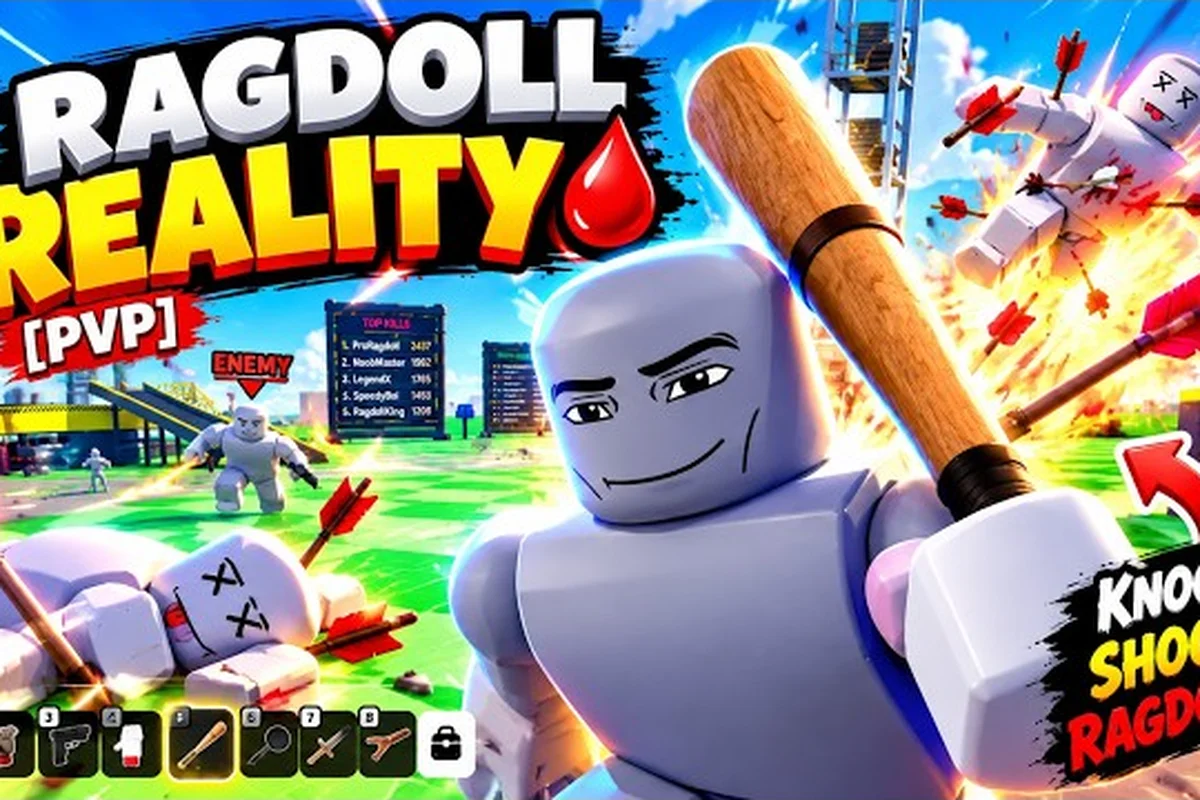
Ragdoll Reality C-tier weapons can still shape a sandbox run through long reach, crowd control, or zombie utility rather than raw damage. Picks such as the Police Car Launcher, Sledgehammer, and Crossbow stand out for letting players create space, stagger groups, or redirect threats; the best option depends on whether your goal is a clear escape route, a defensive choke point, or consistent pressure against nearby zombies.
How Weapon Ranking Is Evaluated
Ragdoll Reality weapon ranking is not based on published damage charts. The official game page identifies more than twenty weapons and names twelve: Fists, Bat and Machete for close impact; Push and Grab as movement tools; Pistol, Shotgun, Sniper and Minigun for range; Rocket Launcher, Flamethrower and C4 for heavy effects, while also mentioning additional releases. Because the page provides no damage values, ammunition totals, fire rates, or cooldowns, a responsible tier list must evaluate practical roles instead of inventing precise statistics.
That distinction is essential when reviewing ragdoll reality c tier weapons. A tier can be low for general power but still offer useful control, reach, crowd separation, or setup value. The same weapon may also become more valuable in a different scenario, especially when the objective shifts from killing individual dummies to surviving a zombie wave.
The official Ragdoll Reality game page is the best source for the current roster and named features. The rankings below are editorial judgments based on those roles, while community reports can help reveal how a weapon feels in practice.
| Evaluation factor | What it measures | Why it matters in Ragdoll Reality |
|---|---|---|
| Damage potential | Expected offensive pressure | Helps finish isolated targets quickly |
| Reach | Safe distance from danger | Preserves positioning around moving dummies |
| Physics control | Ability to move, launch, or pin targets | Creates opportunities beyond direct damage |
| Crowd handling | Ability to manage groups | Supports horde and wave-survival sessions |
| Setup value | Preparation required before useful results | Separates dependable picks from situational ones |
| Reliability | Consistency in ordinary sandbox play | Rewards weapons that work without special conditions |
This method also prevents a familiar trap: assuming the most dramatic weapon is automatically the best. A flamethrower can cover a wide area, but that does not automatically make it the ragdoll reality strongest weapon for every scenario. Likewise, a precise ranged option can be excellent when space is available but less useful when the action becomes chaotic.
What Counts as a C-Tier Pick?
A C-tier designation means a weapon remains functional but does not dominate the available choices. It may lack the efficiency of a higher-tier option, trade raw power for control, or depend on a narrower use case. The label does not mean “bad,” since several entries below are more reliable than a flashy weapon with difficult positioning.
For a broader view of every major role, compare the complete Ragdoll Reality tier list. The key distinction in this guide is narrower: which lower-ranked tools still provide a reason to equip them, and what can each one do that a stronger weapon cannot do as conveniently?
Top C Tier Weapons Compared
The best candidates for this tier share one important trait: they contribute something beyond basic damage. They either control space, move bodies, create a wider attack pattern, or answer a specific environmental objective. Those features can make them more useful in a practical session than a theoretically stronger option that is difficult to deploy.
| Weapon | Best role | Control value | Main limitation | Ideal situation |
|---|---|---|---|---|
| Pistol | General-purpose ranged option | Moderate | Limited crowd pressure | Precise targets with open space |
| Shotgun | Mid-range burst pressure | Moderate | Less effective at long range | Groups entering a medium-distance lane |
| Machete | Close-range cutting tool | Low | Requires danger-close positioning | Tight quarters and rapid follow-ups |
| Bat | Heavy impact option | Moderate | Less forgiving than lighter attacks | Knocking a single target aside |
| Push | Physics manipulation | High | Weak as a conventional damage source | Repositioning bodies and creating space |
| Grab | Direct body control | High | Limited offensive efficiency | Lifting, moving, or arranging dummies |
| Flamethrower | Area denial and fire application | High | Resource use and positioning matter | Sustained pressure against approaching groups |
| C4 | Explosive setup tool | High | Requires deliberate placement | Chained or clustered target setups |
This comparison highlights why ragdoll reality weapons ranked by raw spectacle often miss the practical picture. Push and Grab may not resemble conventional attack weapons, yet their physics interaction can make them invaluable when the goal is to manipulate a scene rather than simply reduce a target.
The Pistol: A Dependable Lower-Tier Choice
The Pistol is the clearest case of a weapon that survives in C tier because it works in nearly every basic sandbox session. It offers a meaningful alternative to unarmed combat, allows the player to attack from a safer distance, and does not demand the elaborate positioning required by explosives or heavy ranged tools.
Its weakness is that it does not specialize as strongly as the Shotgun, Sniper, or Minigun. It may lack the explosive impact of a heavier option, and its value falls when enemies arrive in large numbers. Nevertheless, the Pistol is a useful baseline weapon when you want a simple, responsive tool rather than a setup-heavy strategy.
Reliable ranged baseline is the main reason to keep this weapon equipped. If your preferred play style involves testing ideas, arranging scenarios, and repeatedly engaging targets without constructing an explosive plan, the Pistol can remain useful even when stronger options are available.
The Shotgun: Pressure With Manageable Range
The Shotgun occupies a similar middle ground but leans harder into grouped targets. Its role is strongest at medium or close range, where several dummies can be caught in the same firing window. That makes it a natural companion to the Pistol rather than a complete replacement for it.
The disadvantage is range. When targets remain distant or move unpredictably, a weapon built around close-range bursts becomes less efficient. You also lose much of the Shotgun’s value if your session revolves around precise long-range challenges or isolated physics puzzles.
Medium-range crowd pressure gives the Shotgun its clearest purpose. Community experience commonly treats close-range weapons as more immediately satisfying, while player reports also emphasize that a straightforward ranged option can be safer for testing targets without abandoning the sandbox’s physical chaos.
The Machete and Bat: Different Forms of Close Impact
The Machete and Bat are grouped here because both occupy close-range impact roles, but they should not be treated as identical choices. The Machete favors quick, direct cutting motions, while the Bat fits a heavier swinging profile and stronger impact animation. Neither automatically wins because the official source does not provide comparative damage data.
The Bat is more interesting when a clean hit sends a dummy tumbling or creates distance afterward. The Machete feels more natural for repeated close exchanges where the player wants to remain mobile. Since positioning and animation timing are difficult to measure in a public chart, personal control matters more than an invented damage advantage.
Close-range trade-off defines both choices. The Bat can make a satisfying launch, while the Machete can support faster follow-up movement. They remain worthwhile because ragdoll reality weapons ranked solely by explosion size ignore how often basic melee tools are enough.
Push, Grab, and Physics Utility
Push and Grab are the most underrated ragdoll reality c tier weapons because they reward a different objective. Push redirects a body, while Grab provides direct control over where a dummy moves. In a physics sandbox, that can be more useful than adding another point of damage when the player is trying to stage a crash, move an object, or create a chain reaction.
These tools are not reliable answers to every combat question. Neither is designed to replace a high-output firearm, and prolonged use in a dense wave can leave the player vulnerable. Their value also depends on the player understanding how mass, momentum, and collision objects interact in the moment.
Physics positioning value keeps both relevant in sandbox sessions. Players who enjoy experiments will often get more satisfaction from placing a body precisely than from using a stronger weapon in a generic way. For broader sandbox setup advice, the first-session basics guide can help you learn the game’s core interaction loop.
Why These Picks Sit Below the Top Weapons
The strongest choices in Ragdoll Reality tend to solve more of the combat problem at once. They can produce greater pressure, control larger groups, or remain useful across more situations. The C-tier options below usually require a narrower objective, take more setup, or provide a secondary benefit that is difficult to express in a simple damage ranking.
That is why a complete ragdoll reality best weapon ranked guide should separate overall power from specialist value. A weapon can be excellent for a controlled experiment and mediocre in a chaotic horde, yet it still deserves a place in the overall ranking because players use the game in different ways.
| Ranking question | Favorable answer for a C-tier pick | Unfavorable answer for a C-tier pick |
|---|---|---|
| Can it win a direct fight? | Only in a suitable range or matchup | It depends on constant precision |
| Can it support an experiment? | Yes, especially with physics control | Only when the target is stationary |
| Can it help in a zombie wave? | It slows, separates, or disrupts targets | It contributes almost no useful pressure |
| Is the result satisfying? | Motion, impact, or area is visible | The effect is subtle or inconsistent |
| Does it need special setup? | No for basic utility | Yes for most of its value |
This is an editorial framework rather than an official categorization. The official game page supports the roster details, but it does not publish a tier system, so players should treat the placements as a practical recommendation rather than a measured ranking.
Fists: A Low-Tier Baseline With a Useful Edge
Fists sit at the bottom of most practical rankings because they offer little separation from unarmed play. They do not provide the reach, range, crowd pressure, or physics control that makes the other options distinctive. However, they are not useless in a sandbox that encourages experimentation.
The strongest argument for Fists is access. Players who are manipulating objects, testing grabs, or working through a basic sequence may benefit from having no consumable or ammunition system attached to their chosen tool. A weapon-free state also makes it easier to judge whether a more specialized option is actually improving the experience.
Clean sandbox access is the practical advantage of Fists in Ragdoll Reality. Unlike firearms, explosives, or other C-tier weapons, they require no ammunition, reloads, consumables, or projectile setup, so players can move between grabbing, carrying, and ragdoll-driven interactions without managing an inventory. That makes Fists a dependable baseline for testing movement, physical collisions, and object manipulation, although their short reach and low damage leave them out of contention against automatic fire or explosive crowd control.
C4: Explosive Power With Placement Requirements
C4 is a deceptive C-tier pick. Its explosive nature suggests strong potential, yet its value depends on where it is placed, what it catches, and whether the player can safely trigger the setup. A poorly placed charge wastes an opportunity, while a well-positioned one can transform a cluster of dummies into a chain reaction.
Because the official page does not publish blast radius, fuse duration, damage, or installation rules, comparisons should avoid claiming exact technical superiority. Instead, consider the practical effect. C4 can reward deliberate staging, which makes it especially useful when the player wants to cause a dramatic physics event rather than win a quick exchange.
Planned chain-reaction potential distinguishes C4 from direct firearms because its value comes from how the charge interacts with nearby ragdolls and props. For example, positioning it beside a tightly grouped dummy cluster can produce a larger physics spectacle than aiming a gun at a single target. The trade-off is predictability: C4 performs best in a controlled sandbox where the player can set the trap, create distance, and trigger the explosion, making it less effective during unpredictable emergencies.
Flamethrower: Strong Area Options, Demanding Use
The Flamethrower applies fire and can discourage groups from safely approaching. That makes it a serious candidate when the ragdoll reality best weapon for zombies depends on space control, especially if incoming targets gather along a predictable route. It may also create entertaining physics interactions when burning dummies collide with objects or other characters.
The limitation is that continuous or sustained pressure changes the calculation. Rather than delivering a single decisive impact, fire relies on maintaining an effective position and angle. If a target closes the distance, the weapon may offer less value than a shotgun, pistol, or explosive option.
Area denial is the Flamethrower’s defining advantage in this tier: sustained fire can block a doorway, corridor, or ramp, forcing zombie NPCs to bunch up in the burning lane before the player commits to a shotgun, pistol, or explosive finisher. Its placement among the ragdoll reality c tier weapons therefore reflects situational control and limited stopping power, not weak offensive potential. A wide choke point can amplify the weapon’s value, while its damage falls off once enemies reach melee range or break the intended firing angle.
Best Weapon for Zombies by Situation
Zombie combat changes the ranking because speed, pursuit behavior, and group pressure matter more than in a stationary sandbox test. The official page describes slow, normal, and fast zombie classes, states that zombies chase, pounce, and bite, and also identifies a Horde mode for wave survival. It does not publish zombie health, bite damage, or wave population, so weapon recommendations must focus on observable roles.
For the ragdoll reality best weapon for zombies, there is no universal winner without knowing the mode, available space, and player preference. A weapon that handles a tight corridor may fail in an open arena, while a long-range tool can waste time tracking fast-moving targets. The strongest C-tier choice is the one that solves a specific problem in the current encounter.
| Zombie scenario | Best C-tier candidate | Reason to equip it | Watch for |
|---|---|---|---|
| Tight corridor | Flamethrower | Fire can discourage a group from advancing directly | Maintaining range and angle |
| Fast zombie crossing open space | Pistol | Offers a safer response to a moving target | Accuracy and target speed |
| Medium-range group | Shotgun | Pressure is concentrated at useful distance | Missing when targets spread out |
| Graveyard setup | Grab | Allows deliberate body placement around the conversion area | Exposure while moving a target |
| Stacked or clustered enemies | C4 | Rewards a planned chain reaction | Correct placement and safe distance |
| Loosely organized group | Push | Can create space or redirect one body | Limited sustained damage |
| Close-quarters survivor | Machete | Direct cutting works if positioning holds | Danger from surrounding targets |
The graveyard adds a special layer. According to the official page, throwing a dummy into the graveyard can create a zombie, while a bitten dummy becomes infected and can convert. That means Grab or Push may be more valuable than a damage weapon when the player is intentionally controlling where conversion occurs.
Best C-Tier Option for Large Waves
The Flamethrower and Shotgun make the most sense when a large wave approaches through a readable lane. The Shotgun provides concentrated bursts at medium range, while the Flamethrower discourages continued movement into that lane. Their value depends on the player holding a defensible position instead of chasing scattered enemies.
For more specialized crowd planning, the expert picks for hordes compare several approaches beyond this tier. In practical terms, the C-tier answer is often the weapon that prevents enemies from reaching the player while the player works on a larger objective.
Best C-Tier Option for Fast Zombies
Fast zombies make positioning weapons more attractive. A pistol can provide immediate ranged pressure, but a Machete may be better when the player wants to remain mobile and intercept one target at a time. A Push tool can redirect the approach, buying a moment without requiring an extended attack animation.
The choice depends on control. If you can create a bottleneck, use the area or burst option. If the battlefield is open, a lighter ranged or melee tool may let you reposition better than a heavy weapon. This is where the ragdoll reality strongest weapon question becomes situational rather than numerical.
Best C-Tier Option for Graveyard Conversion
Grab stands out during graveyard experiments because it gives the player direct influence over a body’s position. Push can provide a quicker correction when the target is already in motion, while a Machete or Bat can deliver a decisive impact before conversion occurs. The exact sequence depends on the session’s objective.
The key is to treat conversion as a placement problem. Moving a dummy into the right spot, redirecting a hostile body, or creating a controlled path can matter more than maximizing damage. That makes the ragdoll reality most powerful weapon a poor stand-in for the most useful tool in a physics scenario.
Practical Loadout Advice for C-Tier Choices
A strong C-tier loadout uses tools for different jobs rather than filling every slot with a slightly better version of the same attack. The Pistol provides a general ranged baseline, the Shotgun adds concentrated pressure, and Push or Grab handles manipulation. You can then add a melee tool or an area option for the situations the first three cannot cover.
Players building a ragdoll reality best weapon ranked loadout should begin with the mission they expect to play. If it is a zombie wave, favor space control. If it is a physics challenge, favor positioning tools. If it is mixed sandbox play, keep one dependable attack option and one manipulation tool available.
Test the Situation Before Swapping Weapons
Do not judge a lower-tier weapon by its first animation. A C-tier pick may need a different range, angle, or setup to show its value. Test it under conditions where its strength matters: use the Shotgun against approaching groups, use Push near a useful obstacle, and use Grab when a body needs to go somewhere precise.
| Weapon test | Setup | Useful observation |
|---|---|---|
| Pistol | One isolated moving dummy | Can you engage while preserving movement room? |
| Shotgun | Three dummies approaching together | Does the burst pressure cover the lane? |
| Machete | One dummy at close range | Does direct movement feel controlled? |
| Bat | One dummy beside open space | Is the impact and knockback useful? |
| Push | Dummy beside a wall or obstacle | Does redirected momentum create a useful result? |
| Grab | Several scattered dummies | Can you select and position one body reliably? |
| Flamethrower | A narrow incoming path | Does fire prevent the group from advancing? |
| C4 | A clustered group in a clear area | Does placement create a chain reaction? |
Situation-specific testing is more reliable than a universal tier label. A weapon that seems secondary in a quiet sandbox may become the ideal pick in a horde, and one that feels awkward during a test may excel when positioning a precise physics event.
Keep One Reliable Attack and One Control Tool
A good compromise is a two-purpose setup: one conventional attack weapon for immediate problems and one control weapon for changing the scene. The Pistol plus Grab is a simple example, while the Shotgun plus Push provides more area pressure without giving up body manipulation. This pairing can outperform carrying two loud weapons that solve the same task.
When browsing ragdoll reality weapons ranked lists, look for role labels rather than damage numbers. Ask whether the weapon creates distance, changes direction, covers a group, or produces a strong impact. Each answer represents a practical advantage that can remain relevant even if a stronger option handles routine combat better.
Match the Tool to the Player’s Movement
Your movement style is a meaningful part of weapon ranking. Standing in one position favors the Flamethrower, Shotgun, and C4. Constantly changing position can favor the Pistol, Machete, and Push. If you prefer precise experiments, Grab can reduce the gap between an intended setup and its final result.
The best choice is the one that supports your actions without demanding a complete change in play style. That is the main difference between a strong C-tier pick and a disappointing one: the former complements how you already use the sandbox, while the latter demands a setup that its role does not adequately reward.
The Best Low-Tier Picks in Context
The most useful ragdoll reality c tier weapons are not consistent underdogs, because each one occupies a distinct functional lane. Pistol and Shotgun cover conventional ranged needs at different distances. Machete and Bat provide close impact with different movement profiles. Push and Grab manipulate bodies, while Flamethrower and C4 create area effects with setup requirements.
| Overall choice | Pick | Reason to choose it over another C-tier option |
|---|---|---|
| Best all-purpose C-tier option | Pistol | Simple ranged function with few special requirements |
| Best C-tier group option | Shotgun | Concentrated pressure at medium-to-close range |
| Best C-tier physics option | Grab | Direct control over body placement |
| Best C-tier repositioning option | Push | Quick directional change without needing a full attack |
| Best C-tier area option | Flamethrower | Fire discourages incoming groups along a lane |
| Best C-tier explosion option | C4 | Rewards deliberate placement and chain setups |
| Best C-tier melee option | Machete | Lightweight close-range tool for active movement |
The ragdoll reality strongest weapon may win a standard fight, while the ragdoll reality most powerful weapon may dominate a prepared explosion. Neither necessarily serves a controlled physics puzzle better than Grab. Understanding that distinction keeps a tier list honest and makes every recommendation more useful in practice.
Best role clarity should determine your final choice. Select a weapon because it solves the action in front of you, not because its label sounds impressive. The lower tier is not a punishment; it is a reminder that practical value comes from fit.
Frequently Asked Questions
What is the best C-tier weapon in Ragdoll Reality?
The Pistol is the most versatile C-tier choice because it works across common solo scenarios without elaborate setup. It offers reliable ranged pressure, easy repositioning, and a simpler alternative to fists or heavier weapons. Grab is more specialized, while the Shotgun and Flamethrower excel when groups occupy a predictable lane.
Is Push worth using instead of a damaging weapon?
Yes, when positioning matters more than immediate damage. Push can redirect a dummy, interrupt an approach, or create a collision with another object. It is especially useful in physics experiments and controlled zombie scenarios. Against a fast or relentless target, however, a damaging weapon may secure the result more quickly.
Which C-tier weapon works best against zombies?
The Shotgun is a strong choice for grouped zombies at medium or close range, while the Flamethrower is better for holding a narrow approach. Push can buy space against a fast zombie, and Grab can help control bodies near the graveyard. The best pick depends on wave size, terrain, and whether the player can maintain a safe firing position.
Can C4 outperform higher-ranked explosive weapons?
C4 can outperform a heavier explosive option when placement, timing, and chain reactions are handled well. Its value is greatest against clustered targets or when a dramatic setup is the objective. A single distant target gives it less advantage, so direct weapons remain more practical when precision and immediate damage are required.
How should I choose a weapon from a ranked list?
Choose by role, range, and movement style rather than tier label alone. Compare a weapon’s reach, crowd handling, physics control, setup demands, and reliability in the scenario you expect. The ragdoll reality weapon ranking is most useful when it guides that decision, not when it turns every sandbox session into a search for one universal winner.